
How Duluth Arrests Become Records
Duluth Police Department handles most city arrests. Other agencies also book people in the county seat. The arresting agency writes the incident or arrest report. Once an adult enters county custody, the St. Louis County Sheriff opens the jail booking entry. The official jail roster page states the roster updates hourly. It covers people held from jurisdictions across St. Louis County. Its current PDF can list name, booking number, booking date and time, arresting agency, charges, bail, location, offense level, order type, and projected release date. An image appears when available.
Duluth is the county seat. It is the largest city in St. Louis County, with a July 1, 2024 Census QuickFacts estimate of 87,986 residents. The Duluth Police Department describes roughly 158 officers and 40 civilian staff. Those numbers point to the likely city record holder. Not every police contact becomes a public county booking. The roster bars juvenile distribution. Active-investigation rules can limit what the city releases.
Booking basics: a Duluth arrest becomes a record at intake. The jail logs the name, the charge, and a booking photo.
Where Duluth Recent Arrests Appear
Duluth Police publishes no daily booking blotter. Match each channel to the question it actually answers.
| Channel | Photo? | Status | Best use |
|---|---|---|---|
| County current roster | May render one | Official | Current county custody after booking |
| 48-hour release roster | Check live report | Official | Recent releases, not new arrests |
| DPD press releases | Sometimes | Official city news | Selected incident narratives |
| Northern News Now Crime | Article-specific | News | Regional context, not a roster |
| WDIO Duluth crime | Article-specific | News | Dated reporting |
| SLC Jail Roster | May display one | Unofficial | Discovery only; verify with county |
Start with the official sources. News pages pick which stories to run. Unofficial mirrors can be stale or incomplete. A missing article proves nothing about whether a Duluth arrest happened. The Duluth Police release archive shows how selective that narrative channel is.
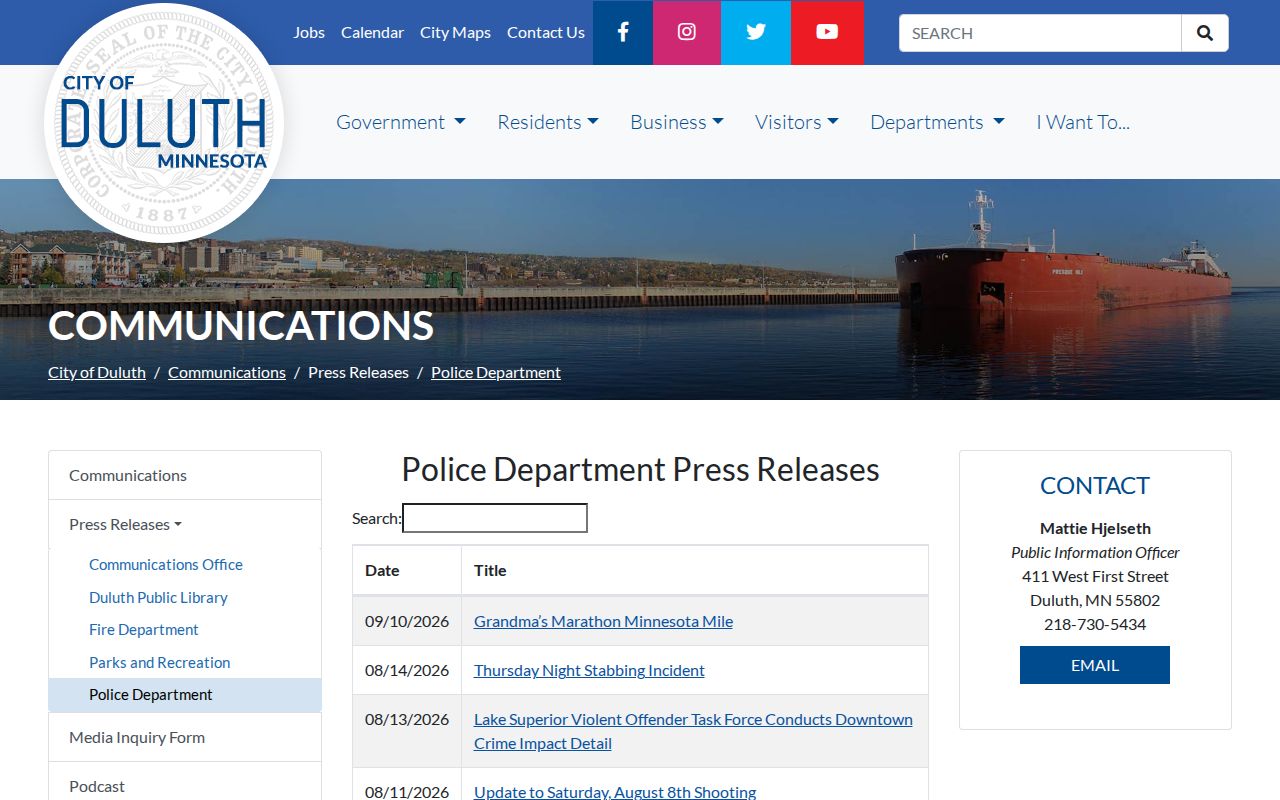
The archive offers useful agency context. Treat it as storytelling, never as a full list of people booked.
Arrested in Duluth: Lookup Steps
- Open the official current roster PDF and use the browser’s Find command for a full or partial name or a known booking number.
- Check the arresting-agency field. A Duluth Police entry connects the county booking with the city-originating arrest.
- If the person is absent, allow for intake. St. Louis County warns that someone can be in intake before a booking number is assigned.
- Check the official 48-hour release roster. It answers whether a recent release may explain removal from the current roster, but it is not an arrest feed.
- Call the county jail at 218-726-2345 for a current custody question, or make a focused request to Duluth Police for the city report.
- Use MCRO or court administration for the case outcome. A roster charge is not a disposition.
The county publishes no verified same-day feed. There is no weekly booking blotter either. The Daily Arrest Report guide covers that narrow window. It does not pretend the roster is a 24-hour cohort. For the full county picture, turn to the guide on St. Louis County recent arrests, which walks through the roster and photo access.
Why an Arrest May Not Appear
The county's own warning explains why "no match" does not mean "no arrest." A booking number must exist before the public entry can appear. A release can also pull someone out of the current snapshot. A transfer can do the same. Juvenile restrictions, a name variation, or a different custody system produce the same result. The county does not publish the intake-to-roster delay. It does not publish the PDF's regeneration minute either. Recheck the official page and call the jail. Then ask the correct agency for a bounded record rather than trusting an unofficial mirror. The St. Louis County jail page describes the county-wide booking destination.
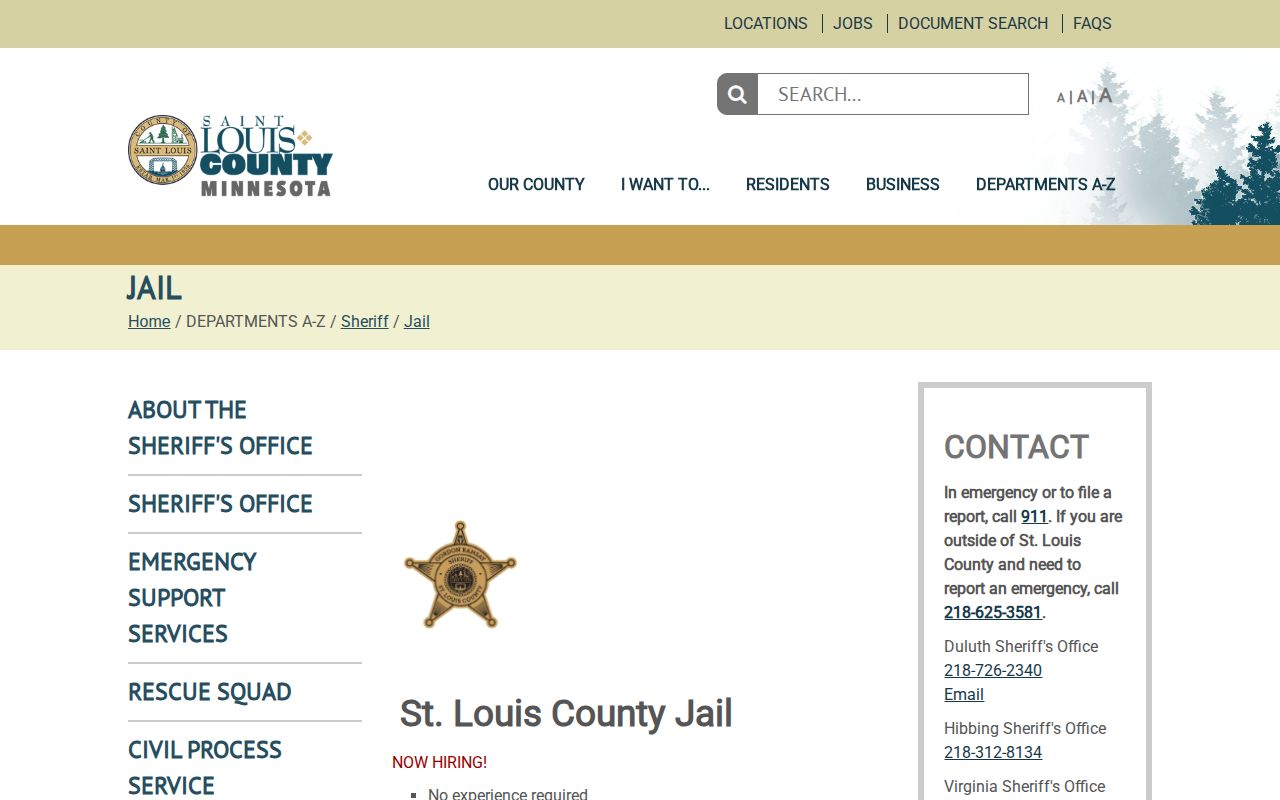
The page also notes transfers. A listed location can change mid-stay for administrative reasons alone.
Duluth Police Arrest Records
Two requests, two custodians. Duluth Police holds the city incident or arrest report. The Sheriff keeps the county booking record and any county-held booking photograph. The DPD police data-request page lists the police data-practices contact at 230 North Arlington Avenue, telephone 218-730-5590, plus policerecords@duluthmn.gov. Inspection is free. Copies carry fees under Minnesota Statutes §13.03, and no fixed copy price applies.
- Give the person’s name and a bounded event date or range.
- Add the incident or case number when known and identify Duluth Police as the arresting agency.
- State whether the request is for an arrest report, incident report, or photograph, and name the desired format.
- If DPD says the requested image is held with the jail booking, use the Sheriff public-data request route.
- Expect redactions or withholding where juvenile, active-investigation, or other Minnesota law applies.
Duluth Police records contact
Duluth Police Department
Police data-practices designee
230 North Arlington Avenue
Duluth, MN 55811
218-730-5590
policerecords@duluthmn.gov
Duluth's city retention schedule keeps arrest reports for seven years and felony reports permanently, following Minnesota Statutes §299C.12. Photographs follow the related item. That is a city schedule, not a promise about Sheriff retention or instant public access.
Adult Data and Privacy
Minnesota Statutes §13.82 generally makes adult arrest data and booking photographs public. The rule has firm limits, though. Duluth policy materials restrict photographing juveniles in custody. The basis is Minnesota Statutes §260B.171, subdivision 5. Active investigations and other statutory exceptions can also affect production. A missing image was not necessarily erased, and the person may still have been booked. Ask the record's custodian and accept any lawful redaction. This page gives source directions and does not host booking-photo galleries.
Duluth News Is Selective
Duluth newsrooms shape the arrest story they tell. Duluth Police releases, Northern News Now, WDIO, and the Duluth News Tribune add context a roster cannot. A report might say where a person was booked or credit a jail-supplied photo. That choice is editorial, not a full list of Duluth recent arrests. Save the publisher, headline, article date, and source link before comparing any story with an official record. SLCJailRoster.com, a county-local site, says its coverage starts April 2, 2026. JailRosters.org runs a secondary daily-PDF index. Treat both as discovery tools only. Check names, booking dates, custody state, and charges against the live county source, then turn to court records for how a case ended. One person can move through several record states. The current roster shows present county custody. The release PDF covers a rolling 48-hour window. DPD holds city-originating material, and the Minnesota DOC viewer concerns sentenced state custody or supervision. MCRO covers cases, not jail intake. Keeping these sources apart keeps them useful.
Duluth Booking and Release States
Name the record state first. Someone fresh off the street may sit in intake, unsearchable. A person with a booking number can show up in the hourly roster. Someone released may drop from the roster yet appear briefly in the 48-hour release report. A later state-prison sentence belongs in the Minnesota Department of Corrections public viewer. That viewer is no recent-arrest feed. Federal holds for the U.S. Marshals Service call for a federal check, not a guess from the local roster. Dates deserve the same care. An incident date and an arrest time can differ. So can a county booking time, news date, release date, and court filing date. Record the source URL and retrieval time. The county PDF regenerates, and its order shifts. For an older Duluth incident, give DPD a narrow date range. Do not ask for every arrest. For an older county booking, use the Sheriff request channel. That habit keeps a changing snapshot from hardening into a false historical claim.
Careful Record Verification
Start with identifiers, not a face. A common name fits more than one person. The live PDF can shift between checks too. Compare the full name, booking number, booking date, arresting agency, and location. Date of birth appears only where supplied, so handle it with care. Charges and bail describe the booking state at that moment. They cannot tell you whether a prosecutor amended a count, whether a judge changed release terms, or how the case ended. When a Duluth Police release and the county roster seem to describe one event, keep each record in its role. The release is a selected city narrative. The roster is a county custody snapshot. A court case is a third source. Match them through an incident number, booking number, case number, dates, and agency attribution. Similar names alone prove nothing. If MCRO name search turns up no pending matter, Minnesota Courts notes some pending criminal cases stay unlisted that way before conviction. Court administration or a known case number may open a better path. Booking photos demand equal restraint. An image may render in the current county PDF. The Sheriff may hold it. It may sit in a DPD record. Availability shifts with the source and lawful limits. A newspaper photo often comes from an agency, but an article is not an official booking archive. Follow the attribution back to the custodian and request the exact record. A missing photo tells you nothing about whether a person was arrested or released.