
St. Louis County Recent Arrests
County booking starts with one document. The St. Louis County Sheriff Jail Roster lists everyone the county currently holds, refreshed as a PDF each hour. It is not a today-only list. A person can sit in booking before staff assign a number, so the newest arrest lags a little. Release removes a name just as fast. Those gaps are why one source is never enough for St. Louis County recent arrests.
The county also posts a 48-hour release roster. It answers who left custody, not who arrived. No official feed covers a full day of bookings or a multi-day arrest blotter. The Daily Arrest Report walks through same-day checks. The Weekly Arrest Log shows how to build a date-range record without mistaking release data for new arrests.
| Official view | Time window | Best use |
|---|---|---|
| Current jail roster | Current custody, updated hourly | Find a booking after a number is assigned |
| 48-hour release roster | Recent releases | Check whether a listed person left custody |
| Public data request | A date range you specify | Obtain older or missing arrest records |
Arrested Last Night in St. Louis
Start with the live roster. Search the PDF with your browser's Find tool. A last name or booking number narrows it fast. But an empty result does not rule out an arrest, since booking can run ahead of the public list, a Range lockup may hold someone briefly, or the person may already be free. The Duluth jail sits at 4334 Haines Road. Staff there can confirm the right custody channel at 218-726-2345. For an incident report, the arresting agency is the better call.
A custody check and a notification request are different tools. The roster shows the present county snapshot. The VINELink Inmate Check follows one person and can send confidential word of a release or transfer. Neither gives the court outcome. Hearings and later rulings live in Minnesota Court Records.
Timing also matters. The county does not publish the exact minute each hourly PDF regenerates or promise a weekend schedule. Wait for the next stated update instead of assuming an overnight arrest should already show.
Search St. Louis Arrest Roster
The official roster covers everyone held in the St. Louis County jail system. The Duluth jail holds 197 beds. Two Range facilities add short-term lockup of up to 72 hours. The jail also keeps people arrested by agencies across the county, fugitives wanted elsewhere, and some U.S. Marshals prisoners. Overcrowding can trigger a transfer to another county. The sheriff calls this routine, not punishment. When it happens, contact the receiving facility. The roster itself is a rendered report rather than a searchable database, so no date, city, or agency filters exist, though its fields allow careful matching:
| Roster field | How to read it |
|---|---|
| Name and booking number | Use the number as the strongest request identifier |
| Booking date and time | May differ from the time of arrest |
| Charge and offense level | Charges as recorded at booking |
| Bail and order type | Current booking terms, subject to court change |
| Arresting agency and location | Points to the office that created the incident record |
| Projected release date | A planning field, not a guaranteed release |
Use the roster in three steps:
- Open the current PDF from the Sheriff's roster page and note its generation date.
- Use Find for the name, then confirm with the booking number, age, agency, and booking time.
- If there is no match, check the release report and contact the jail or originating agency before drawing a conclusion.
The official roster landing page shows the county's timing warning.
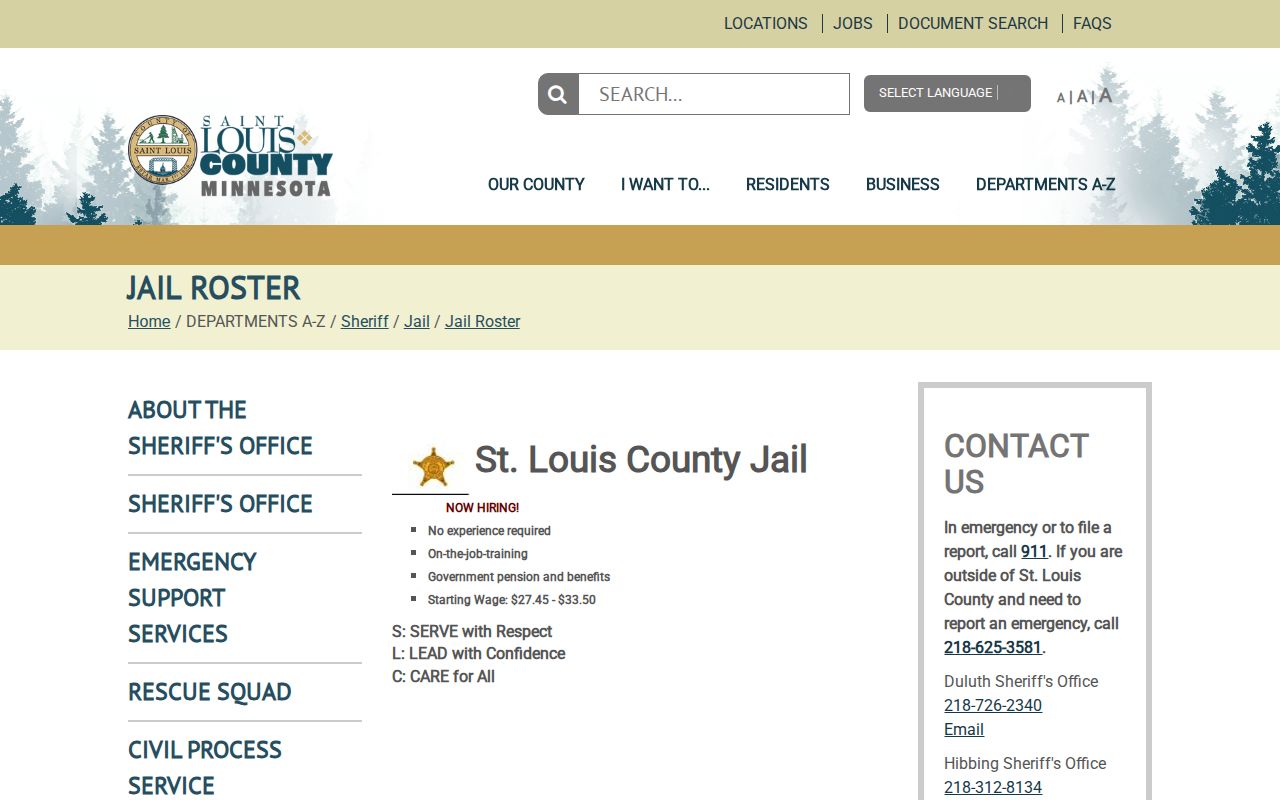
The county roster page hosts the latest PDF. Each visit loads the current version, never a saved copy of the names.
Where St. Louis Arrests Appear
St. Louis County arrest information sits in separate places, split by custody stage and record type. One source answers who is in custody, and another shows who was booked. A third covers what a court later decided. Official sources should lead. News stories and secondary archives add context or cover older dates. They cannot replace the roster, a police record, or a court file.
| Channel | Official? | What it provides |
|---|---|---|
| County jail roster | Yes | Current booking and custody fields, with photos where rendered |
| 48-hour release roster | Yes | A short release window, not new bookings |
| City police releases | Yes | Selected narrative incidents, never a full arrest list |
| County data request | Yes | Specified reports, photographs, and historical public data |
| SLC Jail Roster and JailRosters.org | No | Convenience archives that may be stale or incomplete |
| Local news crime pages | No | Reported events selected by editors |
Unofficial archives exist too. The SLC Jail Roster archive says its coverage begins April 2, 2026. JailRosters.org also indexes the daily PDFs. Treat both as leads only. No working St. Louis County section appears at Busted Newspaper, RecentlyBooked, Mugshots.com, Arrests.org, or Mugshots.zone, and a slick page never proves official status or accuracy.
The unofficial county roster mirror shows that archive interface.
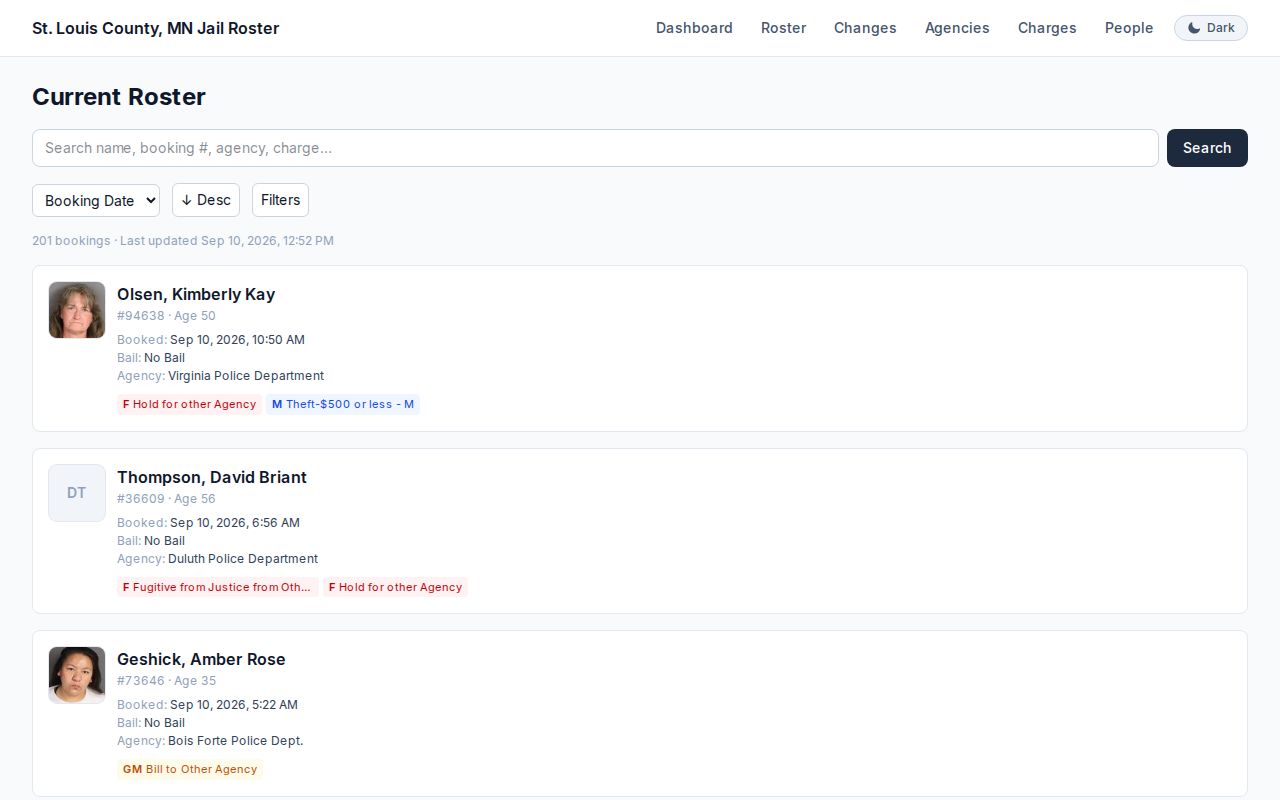
That mirror helps you recognize the service. Verify any result against the sheriff, the police agency, and the court record.
Recent Arrests by City
City police write the originating incident record. The county system handles many adult bookings. That split matters in a county holding Duluth plus two Range lockups. Each city page follows the local police trail first, then ties it to the county roster, the release report, VINE, and the court record.
- Duluth Recent Arrests: Duluth Police releases, police data requests, and county jail bookings.
- Hibbing Recent Arrests: CivicAlert notices, the Hibbing short-term custody layer, and county records.
- Hermantown Recent Arrests: Hermantown Police records, its stated response process, and county custody checks.
No city agency posts a complete daily booking feed. Their press and notice pages are selective. Silence on a city page never rules out an arrest in St. Louis County.
Read a St. Louis Arrest Record
A booking record is an administrative entry. The jail creates it after processing. It can name the arrested person, the booking event, the holding location, and the charges logged at that stage. The booking number matters most. Names can match more than one person, and one person can have several bookings, so that number keeps the record straight.
| Field | Meaning |
|---|---|
| Booking number | County identifier for the custody event |
| Booking date/time | When processing was recorded, not always the arrest time |
| Charges | Accusations listed when the report was produced |
| Bail | Amount or status then recorded, subject to change |
| Order type | Legal basis shown for holding the person |
| Projected release | An estimate that can change |
| Booking photograph | Identity image where public and rendered |
Dispositions live at the courthouse. Search Minnesota Court Records Online for the case file that records the outcome. A defendant-name search may not surface a pending criminal case. The gap holds until conviction. Results can lag behind the actual docket. A case number or a courthouse terminal opens more public information, and the St. Louis County District Court in Duluth is the official follow-through point.
St. Louis Arrest Photos
Booking photos may appear in the live county roster. The county publishes no separate mugshot gallery. Minnesota Statutes section 13.82 generally treats adult arrest data as public. That includes a booking photograph. Limits can still narrow what gets released. Active investigations, identity concerns, and other law can still apply. Juvenile data faces stricter controls. The county's roster page also cites sections 13.85 and 641.05.
If a photograph is missing, use the Sheriff's public data request channel. Ask for that specific booking photograph. Give the booking number, full name, approximate date, and preferred format. The 2026 fee schedule prices printed color photos at $1 each. Digital photographs are prepaid at $25 plus the cost of a storage device. Inspection of public data is free. A city agency may also hold a different photograph from the same incident.
A Minnesota Department of Corrections image belongs to a later state custody or supervision record. It is not the county booking photo. The DOC public viewer does not promise a photo in its search description. Availability there has to be checked case by case.
Request St. Louis Arrest Records
The roster is convenient. For a report or photograph that has rolled off the public PDF, the Sheriff's records unit is the durable route. Minnesota law allows free inspection of public government data. Copy and media costs can still apply. The county posts a fillable Non-BWC data request form and promises a response within a reasonable time, which is a standard rather than a fixed deadline.
- Identify the record with a name, booking number, date range, arresting agency, and incident or case number if known.
- State whether you want inspection or copies, and specify the arrest report, booking photograph, or both.
- Submit the Sheriff's request form through the county's listed channel.
- Review any fee estimate before copies are produced, then compare the result with the court disposition.
100 North 5th Avenue West, Room 103
Duluth, MN 55802
218-726-2340
County questions go to the Sheriff. Its Duluth, Hibbing, and Virginia offices can route them. Duluth, Hibbing, or Hermantown Police may have created the report. That city department is then the proper data authority. The county request page shows the official route for reports, photos, and older data, which keeps a county request from chasing a city-held record.
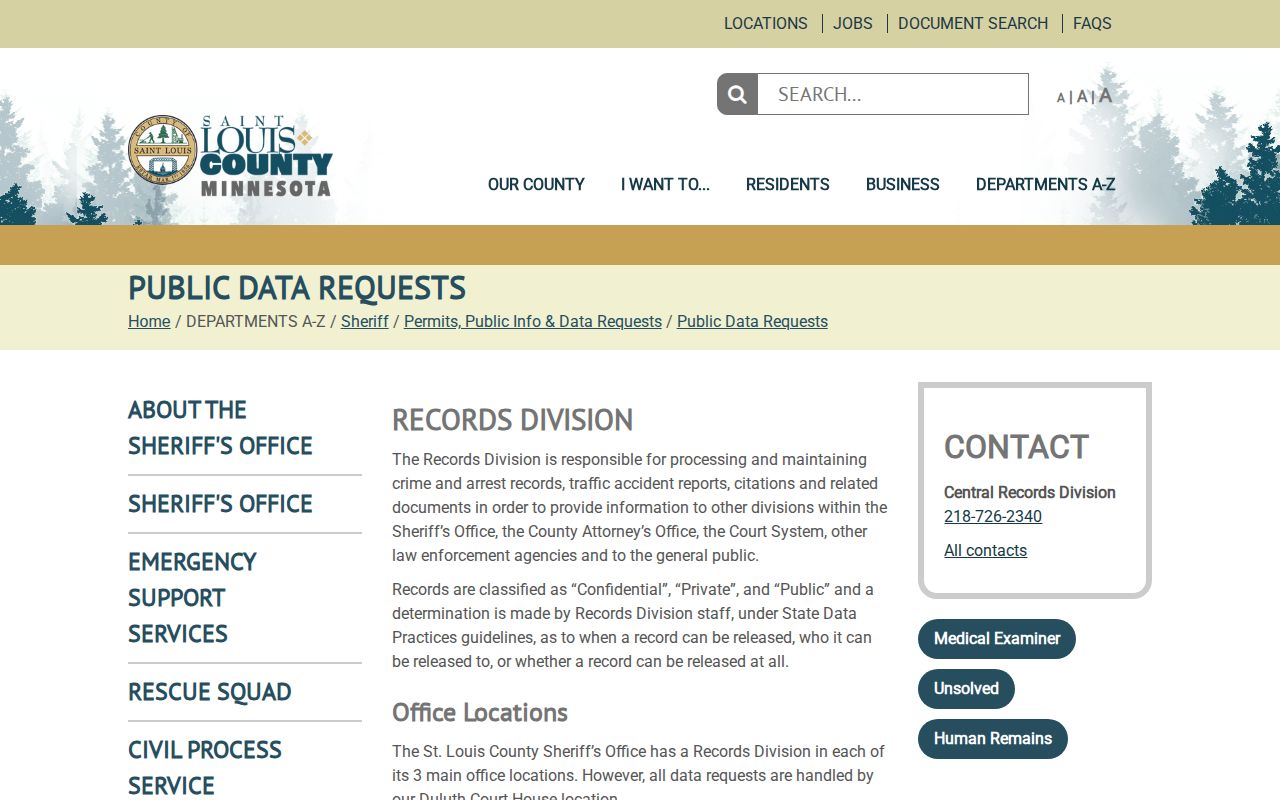
Check the form and current instructions before submitting, since contacts, formats, and charges can change.
Minnesota Arrest Records Law
Minnesota Statutes section 13.82 defines which law-enforcement arrest data is public, and it addresses booking photographs too. Public arrest data can include the time, date, place, resistance, charge, and whether weapons were used. Active investigations, juvenile records, mistaken identity, and safety concerns can all restrict release. Any denial should name its legal basis.
Expungement is a court process that seals qualifying records. Minnesota's automatic-expungement framework sits in section 609A.015. The courts publish EXP101 through EXP106 petition materials for cases needing an application, and eligibility and waiting periods depend on the offense and its result. Sealing a government record is not the same as asking an outside publisher to update its copy.
For third-party copies, use only a publisher's free correction or removal policy. Keep proof of the court outcome. RecentlyBooked publishes a free policy, though no active St. Louis County section appears on it. Avoid any paid removal service. No company can guarantee removal from government sources, and a court order works only within its legal scope. It does not make an unrelated company authoritative.
The Minnesota Data Practices Office explains public law-enforcement data categories. The agency holding the record applies that law to each request.
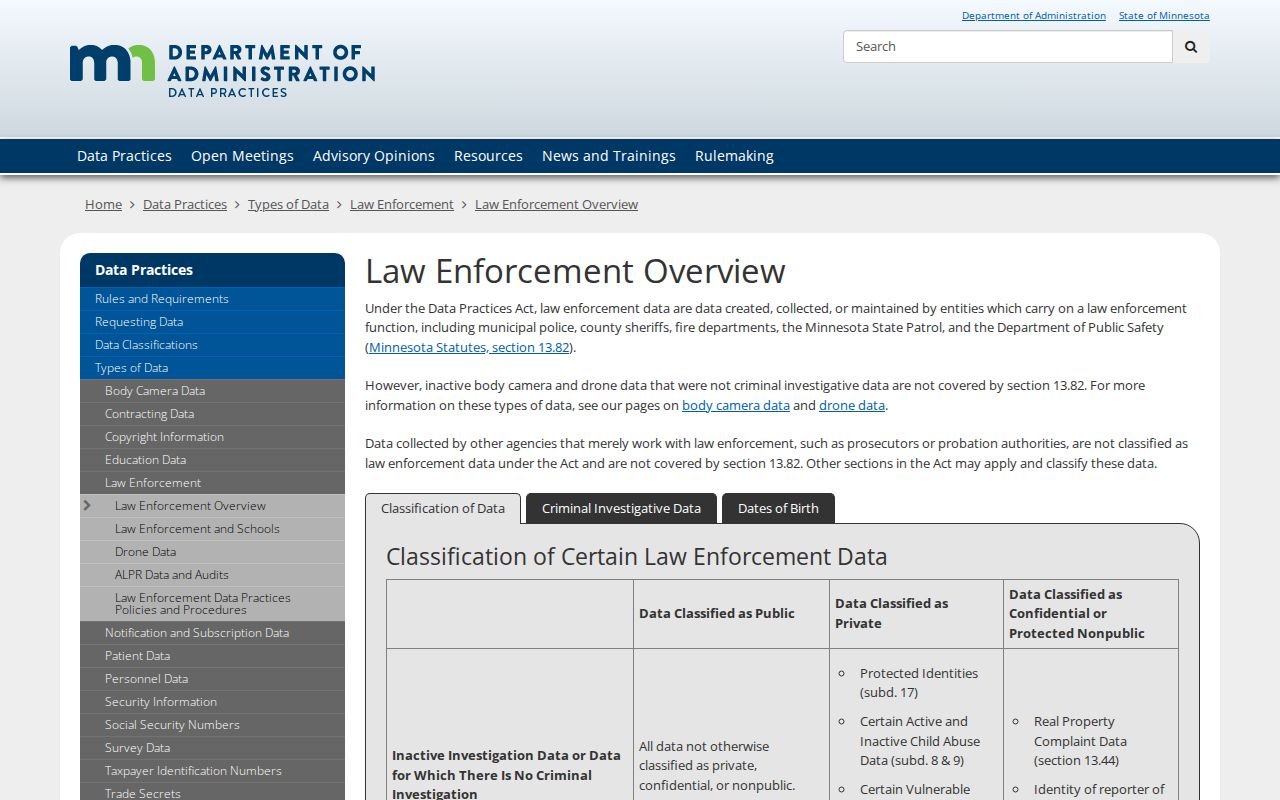
This state page sets the legal frame. The agency holding a particular record is the one that applies the law to each request.
St. Louis Arrest Warrants
The Sheriff posts no single most-wanted gallery. Its Warrant Division page links separate felony and misdemeanor warrant PDFs supplied by the court. Each list can show a name, age, charge, offense level, issue date, bail, and warrant type. Updates run at 9:00 p.m. seven days a week, though the county warns that delays and errors remain possible.
A warrant is a court order authorizing an arrest. Someone checking their own status should contact a lawyer, the court, or the Warrant Division to confirm the order and arrange a lawful resolution. Never approach a person on a warrant list. Tips belong with law enforcement. Emergencies go to 911.
The official Warrant Division page identifies the county lists and safety route.
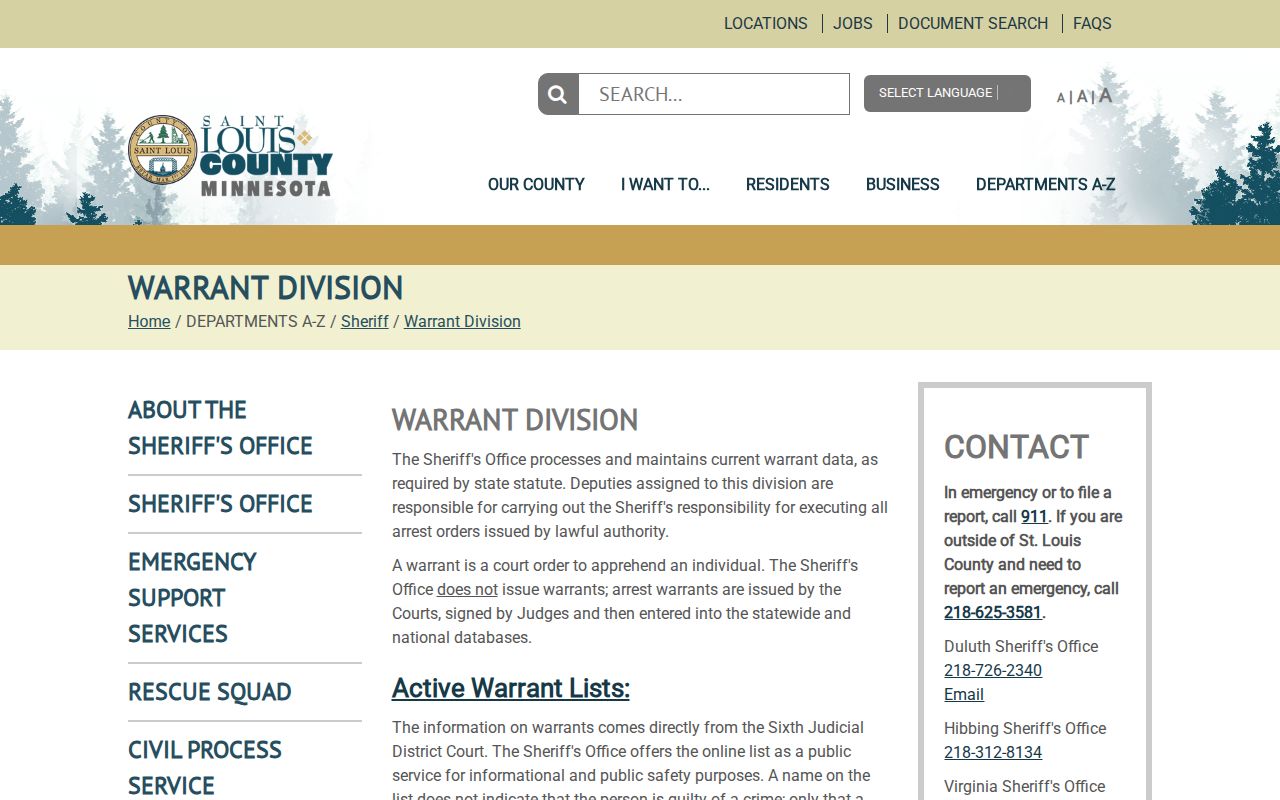
Treat the live PDFs as changeable court data. Copying names into a permanent local list would freeze information the court updates nightly.
After a St. Louis Arrest
Booking ends, but the St. Louis County case has just begun. The arraignment comes first. There the judge names the charge and sets terms for release, with bond as money or a condition attached while the case proceeds. A detainer works differently. It is a hold requested by another authority. So a roster status can change mid-case. MCRO adds what the roster lacks: case numbers, hearings, filings, and a disposition. The public name search has limits, though. Courthouse terminals offer broader access, and only the disposition shows how the case ended.
- Booking
- Administrative intake after an arrest.
- Arraignment
- The early court appearance addressing charges and release.
- Disposition
- The recorded final outcome of a court case.
- Expungement
- A legal process that seals qualifying records.
Custody Beyond St. Louis County
A prison sentence moves a person off the county roster entirely. The state system takes over. The Minnesota Department of Corrections public viewer lists adults under DOC jurisdiction, and a new prison admission may take several business days to appear. Minnesota DOC also runs its own victim notification process. Do not confuse that with county-jail VINE alerts. Federal custody opens a second door. The Federal Bureau of Prisons locator tracks people in federal sentenced custody and posts no booking photos. Someone awaiting federal proceedings often sits under U.S. Marshals authority in a contract facility, sometimes a county jail. Immigration custody splits off again. ICE runs a separate detainee locator. Each tool answers to a different legal system. A missing result only rules out the slice you searched. Match the tool to the custody stage. Turn to the county roster after a local arrest, the release roster after departure, VINE for notice, court records for the outcome, DOC for state prison, and federal tools for federal detention.
Older St. Louis Arrest Records
A live PDF is a poor archive. Once an entry drops off the current or 48-hour report, the public data request becomes the official route to older St. Louis County arrest records. No single retention period covers every Sheriff record series. Ask the records unit which adopted schedule controls the specific jail register, report, photograph, or log. Retention is not guesswork. The Minnesota State Archives local-government guidance explains how approved schedules govern both disposal and transfer. The State Records Disposition Panel is the verification point. Its State Records Disposition Panel page provides the official retention verification route, not a searchable database of people or arrest photographs. Older material has other custodians. The St. Louis County Historical Society works with the Kathryn A. Martin Library archives and may offer a lead on early Sheriff or jail records. None of these paths promise survival. They identify the custodian and the record series. That matters once the live county system no longer answers the question.
St. Louis County Sheriff’s Office Location and Directions
Public Record Search
Sponsored Results